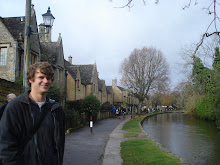
The spring time always provides me with motivation for spending some time with the Romantic poets. William Wordsworth (1770-1850) is one of my favorites, sorry Percy. I recently had the opportunity to visit the beautiful Lake District, the area in Northwestern England where he lived, and it has deepened my interest in his poetry.
A common misconception of the Romantic period and possibly all poetry, and I would say this comes from a person completely unfamiliar with poetry, is that poetry is simply emotions run rampant. True Wordsworth says that "all good poetry is the spontaneous overflow of powerful feelings," but he also adds that no good poems are created with out a person of a "more than usual organic sensibility" who "has also thought long and deeply" (Preface to Lyrical Ballads); thought is not supposed to restrict the composition of the piece but it certainly plays an essential role. Thinking, poetic skill, and emotions are at least three of Wordsworth's necessary conditions for good poetry.
The selection I chose to share comes from Book First (lines 357-400) in "The Prelude: or the Growth of a Poet's Mind, An Autobiographical Poem." At the bottom is this poem turned into a song by Sufjan Stevens (the video isn't great but you can still listen to the song). The song does not address the last section of the speaker leaving "in grave and serious mood," but how many combinations of music and great poets are there? If you enjoy this you might also like lines 425-463--Wordsworth ice skating.
One summer evening (led by her) I found
A little Boat tied to a Willow-tree
Within a rocky cave, its usual home.
Straight I unloosed her chain, and, stepping in,
Pushed from the shore. It was an act of stealth
And troubled pleasure, nor without the voice
Of mountain-echoes did my Boat move on,
Leaving behind her still, on either side,
Small circles glittering idly in the moon,
Until they melted all into one track
Of sparking light. but now, like one who rows
(Proud of his skill) to reach a chosen point
With an unswerving line, I fixed my view
Upon the summit of a craggy ridge,
The horizon's utmost boundary; for above
Was nothing but the stars and the grey sky.
She was an elfin Pinnace; lustlily
I dipped my oars into the silent lake;
And, as i rose upon the stroke, my boat
Went heaving though the Water like a swan:
When, from behind that craggy Steep, till then
The horizon's bound, a huge peak, black and huge,
As if with voluntary power instinct,
Upreared its head.--I struck, and struck again,
And, growing still in stature, the grim Shape
Towered up between me and the stars, and still,
For so it seemed, with purpose of its own
And measure motion, like a living Thing
Strode after me. With trembling oars I turned,
And through the silent water stole my way
Back to the Covert of the Willow-tree;
There, in her mooring-place, I left my Bark,--
And through the meadows homeward went, in grave
And serious mood; but after I had seen
That spectacle, for many days, my brain
Worked with a dim and undetermined sense
Of unknown modes of being; o'er my thoughts
There hung a darkness, call it solitude
Or blank desertion. No familiar Shapes
Remained, no pleasant images of trees,
Of sea or Sky, no colours of green fields,
But huge and mighty Forms, that do not live
Like living men, moved slowly through the mind
By day, and were a trouble to my dreams.